Dynamics Multilingual Services · 6 min read
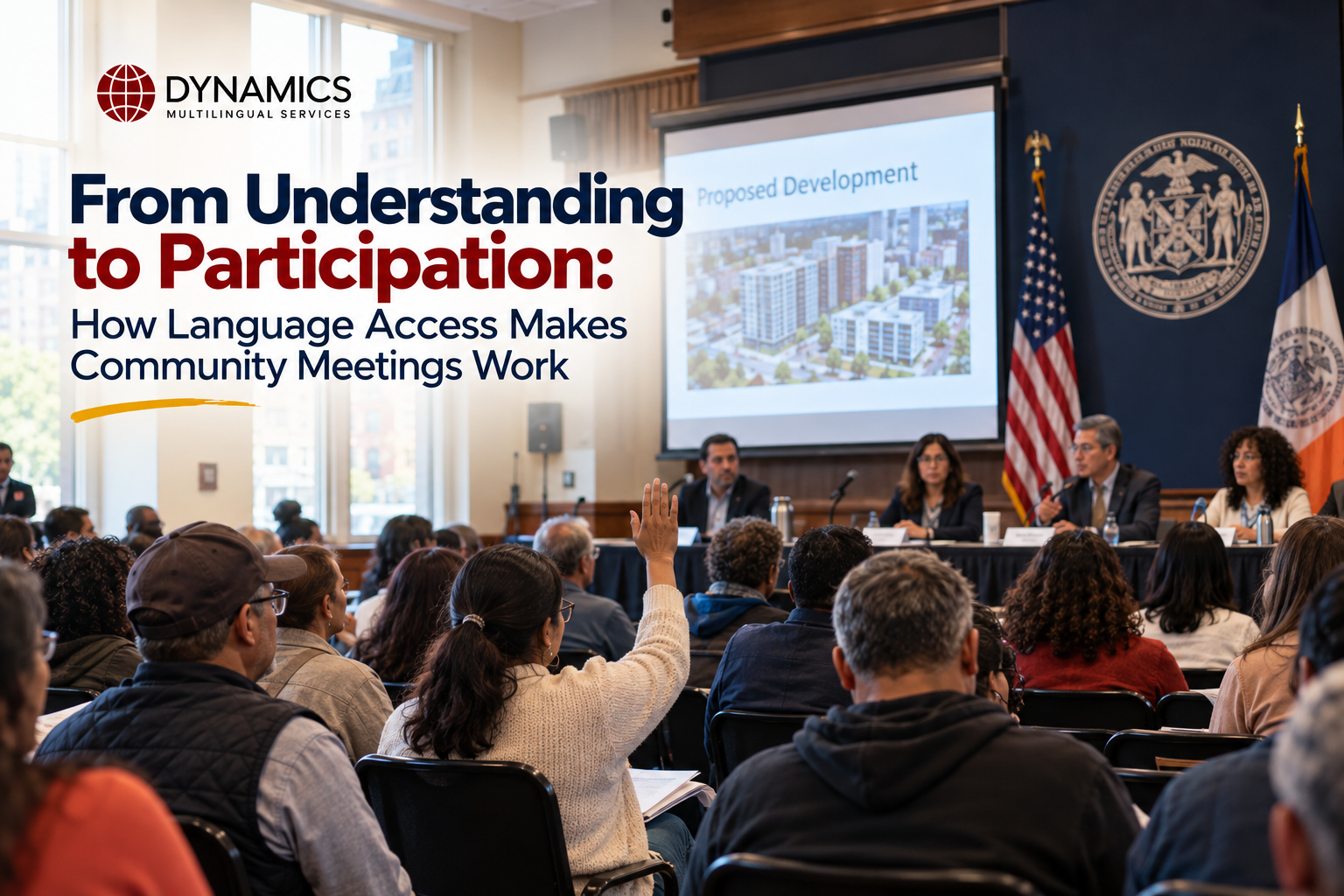
Picture a community meeting on a Tuesday night. The room is full. There’s a presentation on a new development proposal, a few slides on traffic and air quality, and time at the end for public comment. Half the residents in the room speak Spanish as their first language.
The organizers did the right thing and booked an interpreter. Residents put on headsets and follow along. On paper, the meeting was accessible.
But when the slides came up, they were only in English. When the facilitator split the room into small groups, the interpreter could only be in one place. When public comment opened, the Spanish-speaking residents who had followed every word stayed seated, because nobody had explained how their comments would be heard.
They understood the meeting. They just weren’t part of it.
Understanding is the starting point
For a community meeting to work, residents first need to understand what’s being said, and that’s more than the spoken presentation. It includes:
- The materials. Agendas, slides, handouts and maps should be available in the languages people in the room speak, ideally shared before the meeting so residents come in prepared.
- The technical language. Community meetings are full of terms like zoning variance, emissions permits and rezoning, which are hard enough in your first language. A good interpreter prepares for this ahead of time, and a quick briefing from the organizer makes a big difference.
- The context. Why is this meeting happening, what’s being decided and when? If residents don’t know what’s at stake, understanding the words only goes so far.
Taking part is the goal
A community meeting exists so residents can shape what happens in their neighborhood. That means everyone in the room should be able to:
- Ask questions and get answers in real time, in the language they think in.
- Give public comment knowing it will be heard by decision-makers in full, not summarized or skipped.
- Join small-group discussions, which often need more than one interpreter or a plan for how groups are organized by language.
- Follow up afterward, with notes, next steps and contact information in their language.
When any of these break down, residents learn the meeting wasn’t really built for them. The next month, fewer of them come back.
Why it matters
Organizations like WE ACT for Environmental Justice hold regular public meetings where residents need to follow along in Spanish. The topics affect people’s health, housing and neighborhoods directly. When those residents can understand and take part, organizers hear from the whole community instead of just part of it. The decisions that come out of the room reflect the people who live with them.
This builds trust over time too. Residents who see interpretation at every meeting, materials in their language and their comments taken seriously start to believe their voice counts. That’s what turns attendance into participation.
What it takes
Making a meeting fully accessible doesn’t have to be complicated, but it does need a plan:
- Before the meeting: Translate outreach and materials, confirm how many residents need interpretation and brief your interpreters on the topic.
- At the door: Announce interpretation clearly, have headsets ready and let residents know they can speak in their own language.
- During the meeting: Make sure interpretation works in both directions, so residents can listen and be heard. Plan for breakout groups and public comment.
- After the meeting: Share notes and next steps in every language represented in the room.
How DMS helps
Since 2005, Dynamics Multilingual Services has provided simultaneous interpreting, translation and audio equipment for organizations that bring communities together. We handle the interpreters, the headsets and the materials, so your team can focus on running the meeting and every resident can take part in it.
If your organization holds recurring community meetings, we’d be glad to help you build a language access plan that works month after month.