Dynamics Multilingual Services · 8 min read
It’s conference night. Teachers have back-to-back 15-minute slots from 4:00 to 7:00 PM. Twenty of the families on the schedule speak Spanish at home, and a few more speak Haitian Creole or Portuguese. The school has one bilingual staff member, and she’s supposed to be in her own classroom meeting her own families.
By 5:30, conferences are running behind. A parent waiting in the hallway leaves before her turn. Another sits through a conference while her fifth grader interprets what the teacher is saying about his own grades.
Most schools want every family at the table. The hard part is that parent-teacher conferences make language access a scheduling problem, and that problem needs to be solved before conference night, not during it.
Why parent-teacher conferences are different from other school events
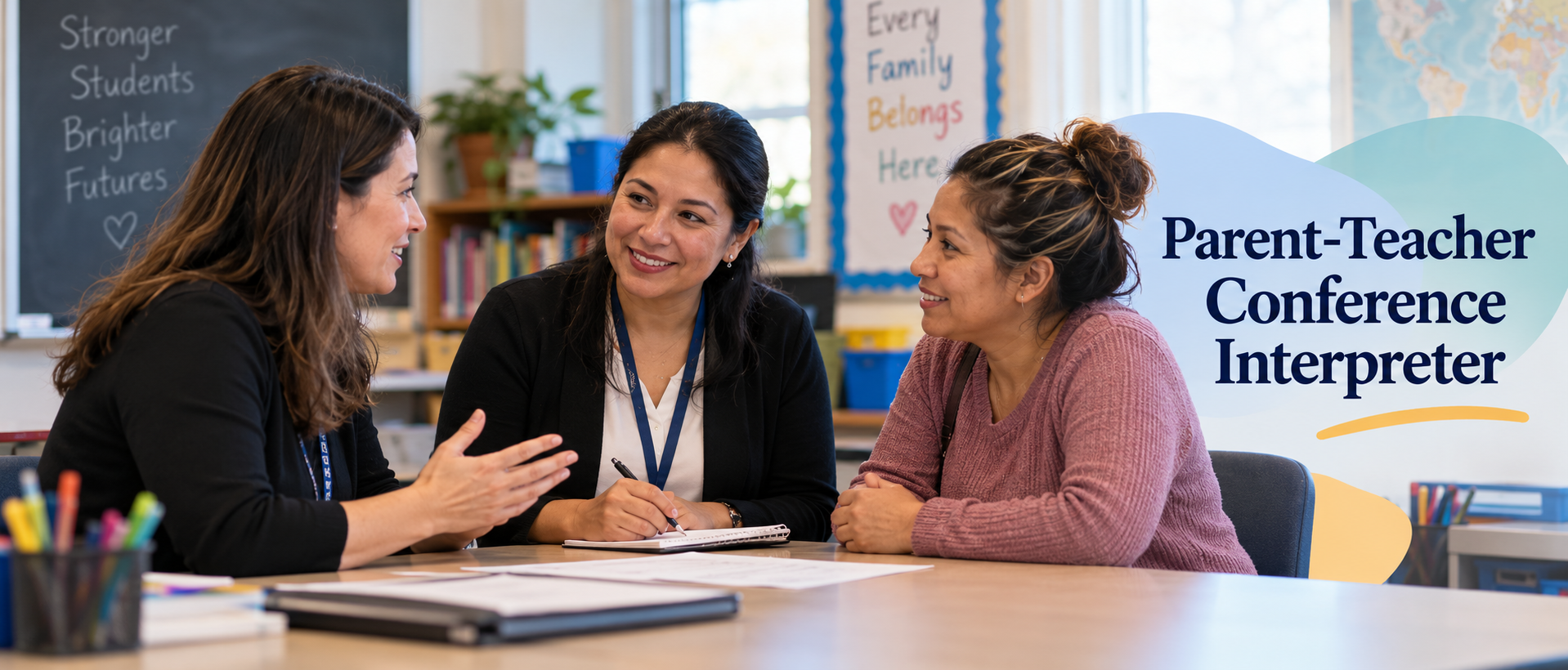
At a graduation or a back-to-school night, one interpreter can cover a whole room with simultaneous interpretation and headsets. Conferences don’t work that way. They are:
- One-on-one. Each conversation is between a teacher and a family, usually in a separate classroom.
- Happening at the same time. Ten teachers may be holding conferences at once.
- Tightly timed. Fifteen minutes goes fast, and interpretation adds time to every exchange.
- Personal. Grades, behavior, reading levels and sometimes concerns about a child’s progress. These aren’t conversations a parent should have to half-understand.
That’s why conferences need their own interpretation plan, separate from the rest of the school calendar.
How many parent-teacher conference interpreters do you need?
Start with a simple count. If 20 Spanish-speaking families are scheduled in 15-minute slots over three hours, a single interpreter can cover about 12 conferences if every slot lines up perfectly. They rarely do. Two Spanish interpreters gives you room for delays, families who arrive late and teachers who run over.
Then look at your other languages. If only two or three families speak a less common language, a scheduled phone or video interpreter for those slots can work well, as long as it’s booked ahead of time.
Five ways to make conference night run smoothly
1. Ask families about language when they sign up. Add one question to your conference sign-up form: “What language would you like to use at your conference?” This one line tells you exactly how many interpreters you need and for which languages.
2. Group interpreted conferences together. Instead of scattering Spanish-speaking families across the whole evening, schedule them in blocks. This keeps interpreters moving efficiently from room to room instead of waiting between slots.
3. Set up an interpreter home base. Give interpreters a central spot near the classrooms, along with a printed schedule showing which room they need to be in and when. Front office staff always know where to find them.
4. Brief your interpreters in advance. Share your grading system, report card terms and any programs teachers might mention, such as reading intervention, ESL services or after-school tutoring. Five minutes of prep helps the interpreter explain the details clearly.
5. Never rely on students to interpret. Children shouldn’t be put in the position of delivering news about their own grades or behavior to their parents. It also puts a lot of pressure on the student, and parents may not get the full picture.
What to have translated before conference night
Interpretation covers the conversation. Translation covers what families take home. Before conferences, consider translating:
- The conference invitation and sign-up form
- Report card terms or a one-page guide to your grading system
- Any handouts teachers plan to share, like reading tips or program information
- Follow-up steps and teacher contact information
When families arrive already knowing what to expect, conferences go faster and the conversation goes further.
Why it matters
Parent-teacher conferences are often the one time each semester a family sits down face-to-face with their child’s teacher. For families who speak a language other than English, it may be the only real chance to ask questions, share what they see at home and understand how their child is doing.
When that conversation happens through a professional interpreter, the teacher hears from the parent and the parent hears from the teacher, with nothing lost in between. That builds the kind of trust that carries through the rest of the school year.
Frequently asked questions
What type of interpretation is used for parent-teacher conferences?
Usually consecutive interpretation. The interpreter sits with the teacher and family and interprets after each person speaks. It works well for one-on-one conversations and doesn’t require headsets or equipment.
Can we use bilingual staff instead of hiring an interpreter?
Bilingual staff are a big help, but on conference night they usually have their own families to meet. Professional interpreters let staff focus on their own conferences while every family gets full coverage.
How far in advance should we book interpreters for conferences?
As early as possible. Conference dates often fall within the same few weeks across many districts, so interpreter availability tightens quickly. Booking once your conference dates are set is the safest approach.
What if we have families who speak less common languages?
Scheduled phone or video interpretation works well for a small number of conferences in less common languages, as long as the time slots are confirmed in advance.
Parent-teacher conference interpreters from DMS
Since 2005, Dynamics Multilingual Services has provided interpretation and translation for schools across New Jersey and New York, from graduations and PTA meetings to parent conferences and board meetings. We’ll help you plan your staffing and translate your conference materials, and we’ll brief our interpreters so every family can take part in the conversation about their child.