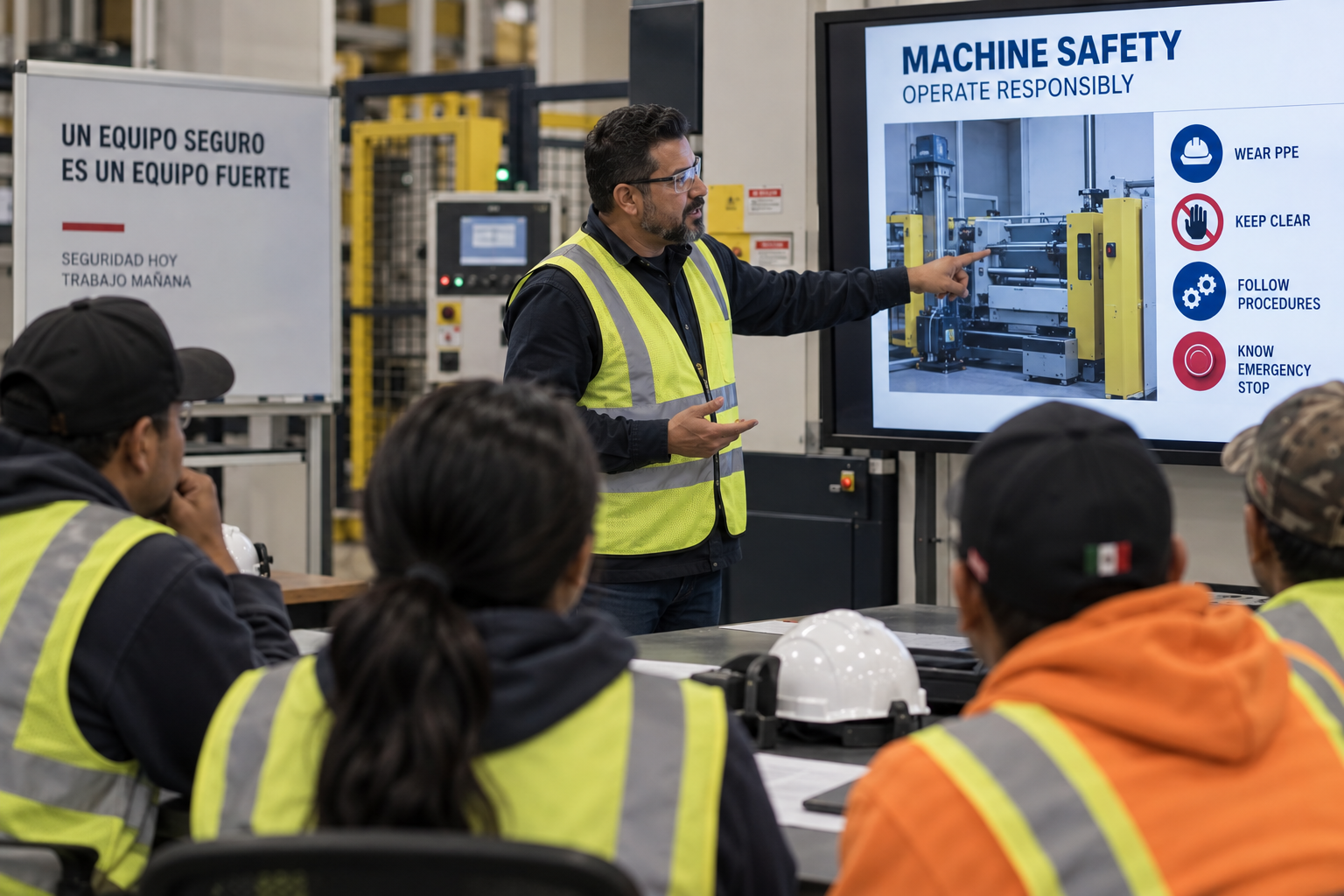
A safety briefing delivered in a language part of your workforce doesn’t fully understand isn’t a safety briefing — it’s a liability waiting to surface.
Dynamics Multilingual Services · 6 min read
Picture this: a new piece of machinery arrives at a manufacturing facility.
Before anyone can operate it, the team goes through the required safety training. The instructor explains the controls, what can go wrong, what not to touch, and what to do in an emergency.
The problem? The entire training is in English, and several employees in the room are much more comfortable communicating in another language.
They listen. They watch the demonstration. They may even nod when asked if everything is clear.
But did they actually understand it?
That difference matters.
Being in the room doesn’t mean someone was trained
When we think about workplace safety, we usually think about the physical things: protective equipment, warning signs, machine guards, emergency exits.
Communication is part of that safety system too.
If an employee doesn’t fully understand how to shut down a machine, handle a chemical, or respond during an emergency, having the correct procedure written somewhere isn’t enough.
The procedure has to be understood.
OSHA requires employers to provide safety training in a language and vocabulary workers can understand. That becomes especially important in workplaces where employees speak multiple languages or have different levels of English proficiency.
And this isn’t just about translating a few signs around the facility.
It’s about making sure the person receiving the information can actually use it when it matters.
Where language gaps can become safety gaps
Some situations leave very little room for misunderstanding.
New equipment and machinery
Before an employee operates unfamiliar equipment, they need to understand more than which button turns it on. Lockout procedures, warning signals, emergency stops, maintenance requirements, and operating limits all matter.
Missing one part of those instructions can have serious consequences.
Hazard communication
Chemical labels, Safety Data Sheets, handling instructions, and exposure procedures contain specific information for a reason.
This isn’t the kind of information that should be summarized casually by a bilingual coworker or explained with “basically, what this means is…”
Technical safety information needs to remain accurate.
Emergency procedures
During an emergency, there isn’t much time to stop and translate.
Workers should already know where to go, what an alarm means, who to contact, and what steps they’re expected to follow.
Those instructions need to be clear before the emergency happens.
The question employers should be asking
After a safety meeting, it’s easy to ask:
“Did everyone attend the training?”
A better question is:
“Did everyone understand the training?”
Those are not the same thing.
A worker who sat through a 45-minute safety briefing in a language they only partially understood may technically have attended. But attendance alone doesn’t make a workplace safer.
Understanding does.
Safety should never depend on someone’s English proficiency
Multilingual workplaces are a normal part of today’s workforce. The solution isn’t to lower expectations or simplify important safety information.
It’s to make that information accessible.
Professional interpreters can support safety orientations, new-hire onboarding, equipment training, hazard communication, toolbox talks, and other situations where employers need to know that the message being delivered is the message employees are actually receiving.
At Dynamics Multilingual Services, we provide professional interpretation for workplace training and safety communication in more than 20 languages.
Because when the information involves someone’s safety, “I think they understood” isn’t good enough.
Every worker deserves to understand the information designed to keep them safe.