Think about the people caring for young children in your community. Some run family child care programs out of their homes. Some are lead teachers in centers. Some are assistant teachers working toward a credential. In many New Jersey and New York communities, a lot of them speak Spanish as their first language, and many of them speak Spanish all day with the children and families they serve.
Then a required training comes up on health and safety, child development or a new state regulation, and it’s only offered in English.
Providers show up because they have to. They sit through it, catch what they can and leave with a certificate. But did they get what the training was designed to teach?
For early childhood organizations that train and support providers, interpretation for early childhood training is how you close that gap.
Why language matters in provider training
Early childhood training isn’t light material. Providers are learning about:
- Health and safety: safe sleep, allergies, medication, emergency plans
- Child development: milestones, early literacy, social-emotional growth
- Regulations and licensing: what’s required, what’s changing and how to stay in compliance
- Working with families: communication, screenings and referrals
These topics directly affect children’s safety and learning. A provider who half-understands a safe sleep training or a new licensing rule is a risk no organization wants. A provider who fully understands it is better at their job, more confident and more likely to stay in the field.
Interpretation vs. separate Spanish sessions
Some organizations try to solve this by running separate Spanish-language sessions. That can work when you have a bilingual trainer and enough providers to fill a room. But it often means:
- Spanish sessions are offered less often, so providers wait longer for required training
- Content gets out of sync between the English and Spanish versions
- Providers who speak different languages never learn together or share ideas
Interpretation lets you run one training for everyone. English-speaking and Spanish-speaking providers sit in the same room, hear the same content and take part in the same discussion.
What interpretation for early childhood training looks like
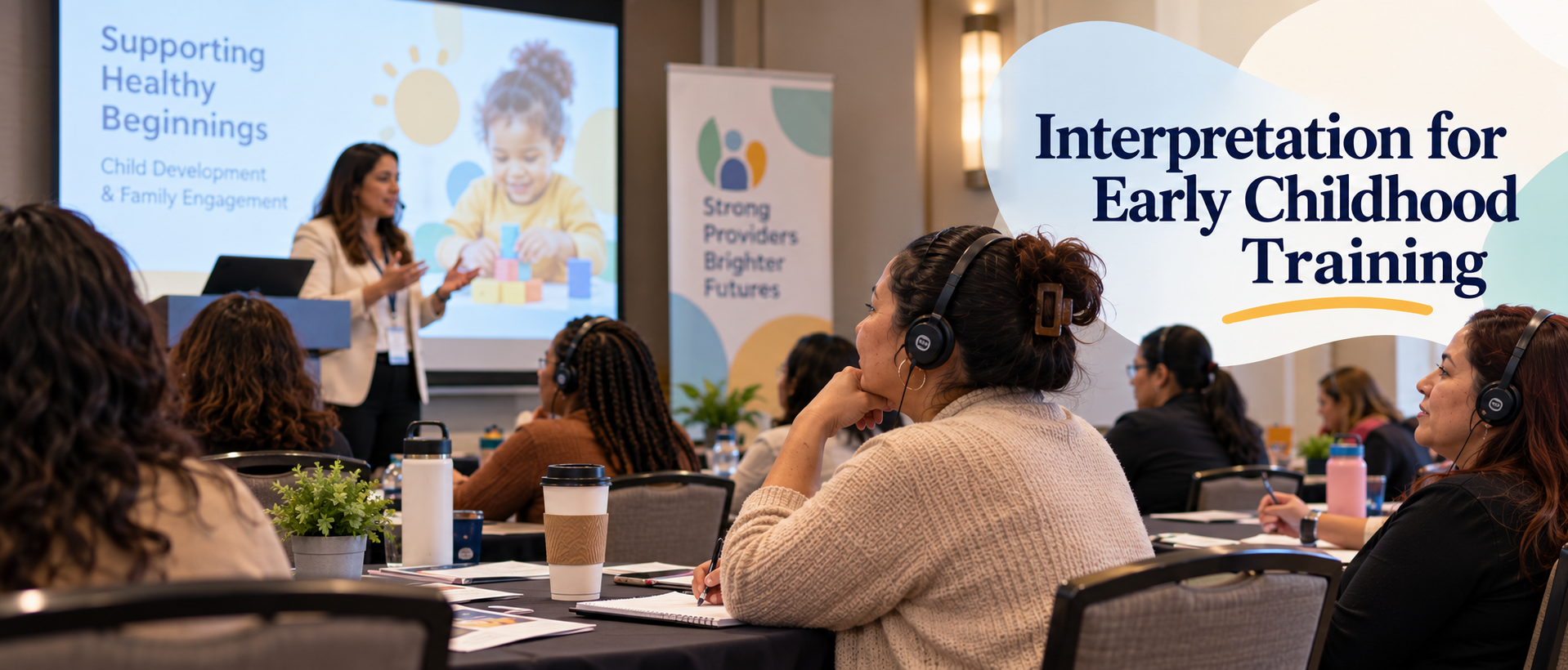
Live, in-person trainings and workshops. Simultaneous interpretation with wireless headsets lets Spanish-speaking providers follow the trainer in real time. When they ask a question or share an example, the interpreter brings it back to the room in English.
Multi-session courses and credential programs. For a series of trainings, keeping the same interpreters across every session helps with consistency. They learn the trainer’s style, the course terms and the group, which makes each session smoother than the last.
Virtual trainings. Many provider trainings now happen on Zoom. Zoom’s language interpretation feature lets providers choose their language channel and listen in Spanish while the trainer presents.
Translated materials. Handouts, slides, sign-in sheets, evaluations and certificates should be translated too. Providers keep these materials and refer back to them long after the training ends.
How to plan interpreted provider trainings
- Ask providers about language at registration. One question tells you how many interpreters and headsets you need.
- Share materials with interpreters in advance. Early childhood training is full of specific terms, and an interpreter who has reviewed the slides will deliver them more accurately.
- Build in time for questions. Interpreted Q&A takes slightly longer, and it’s often where providers learn the most.
- Plan for the whole series. If your organization runs ongoing trainings, schedule interpretation for the full calendar instead of booking one session at a time.
Why this matters for early childhood organizations
Organizations that support child care providers through resource and referral, professional development, coaching or membership all share the same goal: high-quality care for young children. Providers are the ones who deliver it.
When training happens in the language providers are most comfortable learning in, they come away with more than a certificate. They come away ready to use what they learned with the children in their care.
Frequently asked questions
What type of interpretation works best for provider trainings?
Simultaneous interpretation with headsets is usually best for workshops and classes, because the training keeps its normal pace. For small groups, consecutive interpretation can also work.
Can interpretation work for virtual trainings?
Yes. Platforms like Zoom have built-in interpretation features that let participants choose a Spanish audio channel while the trainer presents.
Should we translate training materials too?
Yes. Translated handouts, slides and evaluations help providers follow along and keep the information after the training ends.
Do you only provide Spanish interpretation?
No. Spanish is the most common request in early childhood settings, but we also provide interpretation in other languages based on the communities you serve.
Interpretation for early childhood training from DMS
Since 2005, Dynamics Multilingual Services has provided interpretation, translation and equipment for early childhood and training programs across the USA. We serve as the interpretation team for the Statewide Hispanic Chamber of Commerce of New Jersey’s multi-week bilingual training programs, and we support Head Start and early childhood conferences across the nation. We know what it takes to keep a training series consistent from the first session to the last.